
Articles & Reviews
Sony NEX-FS700 in the Raw
At NAB 2013, Sony announced the raw upgrade for the NEX-FS700, allowing this $7500 camera to send raw 2K and 4K video to external recorders. In the middle of May, Sony sent me a prototype raw-enabled FS700 camera, an IFR5 raw adapter, and an AXS-R5 recorder. After ten days of frantic shooting, grading, and editing, Art and I presented “FS700 in the Raw” at Cine Gear Expo. Most of what Art discussed he’s written about here; what follows is my part of the presentation.
Review: Vinten Vision blue3 Camera Support System
The Vision blue3 is the third Camera Support System in the blue series, sitting somewhere between the original Vb, and the Vb5 I reviewed last year. The “blueBridge” Small Camera Adapter (SCA) is Vinten’s take, and an extremely well thought out one, on a Centre of Gravity (COG) lifter, a subject I talked about briefly last year in the Vb5 review. The only thing that has changed between the Vb and the Vb3 is a different spring rate. The sticks, case, spreader and head are in all respects identical down to the last detail, but for that spring change. So, if you want all the details, refer to my original Vb review. For this review of the Vision blue3, I’ll skip the usual format and concentrate on the Vb3’s place in the blue hierarchy, the measurable differences between their individual spring rates and, additionally, the effect of using the blueBridge SCA with them both.
Making the Sony F55 Look “Filmic” with Resolve 9
I’ve spent a long time learning to make HD footage look “filmic” without really knowing exactly what that meant. I’ve just picked up a bit of insight, however, and it’s permanently changed how I look at video and color. I’ve shot a number of projects using an Arri Alexa in WYSIWYG mode — for which I’m considered a bit of an oddity — but with it I can get great results with no more than minimal grading and clients love walking away with ProRes files whose look is 90% there. My problem is that I now have to do this with other cameras as Alexa’s price point is considered “high” in my market due to the release of several newer, cheaper and fairly capable cameras. I love the Alexa look, but my current task is to figure out how to get close to that look when the production doesn’t have the budget to rent one — or, more likely, in the event the production company owns their own camera.
OS X: Fixing AVCHD media to avoid the dreaded “CANNOT OPEN”
If you’re using OS X and you copy AVCHD media folders to a NAS (network-attached storage) or a case-sensitive disk, you may run into problems: opening the media in 10.8’s Finder gives you “CANNOT OPEN” instead of a clip browser, FCP X can’t see the clips, and so on. Fortunately, you can fix this.
Relaying Light: Using Diffusion to “Fix” Natural Light
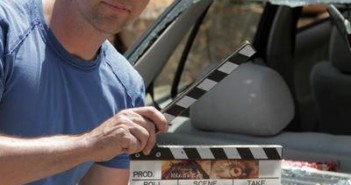
Diffusion doesn’t just soften light; it relays light. Here’s how I used a large piece of dense diffusion to light the inside of a car and hide the little known fact that the sun moves.
This spot was the first in a series of six that I shot two years ago for OnLive, a company that specializes in streaming gameplay over the Internet. They went through some rough times but now they’re back and they’ve decided to release these spots as part of a new ad campaign.
My lighting budget had to cover the needs of all six spots over five days, so I had to build an equipment package that worked for everything. This car was the only location that would normally have required some big lights to balance a dark car interior with a day-lit exterior and keep the quality and direction of light consistent over time, but we didn’t have the money for a generator and a couple of large HMIs. Fortunately I had two tricks up my sleeve: an Arri Alexa and a 12′x12′ frame of full grid cloth.
DJI Phantom – Flying Commercially in the UK
To me the Phantom is a tool to which I can attach a camera to take stunning photographs or video from an angle that is totally alien to us. To some and sadly a few of our newspapers the Phantom is a drone, a device which is seen as being used for surveillance, to strip away our privacy. As responsible pilots we need to act in a manner that doesn’t harm this emerging market for aerial video and photography. My fear is that sooner or later a member of the public will be hurt by somebody flying irresponsibly. The press that will follow will put all multirotor pilots in the spotlight in a negative way.
My involvement with multirotors has up to this stage been as a hobbyist. I was introduced by a friend to this technology about 18 months ago and have fallen in love with it. I was involved with building my first rig, went on to buy a Phantom and have almost finished building the larger DJI S800. From this point on my interests are of a commercial nature, I want to provide aerial footage to a niche and specific market. To do this though however brings about what appears on the surface to be another set of complexities.
NAB 2013 Reflections
In Ye Olden Days, every part of the production, storage, postproduction, and transmission chain was built around analog hardware following well-defined standards: 3.58 MHz subcarrier, 13.5 MHz digital sampling; format-specific tape decks, NTSC II encoding and OTA transmission. Moving to HD required replacing all of that with something new.
Now? Sensors and displays are hardware, but the stuff in the middle is a string of ones and zeroes. There aren’t hardware vision mixers any more, just T-handles driving encoders that tell DSPs what proportion of channel A to composite with Channel B. A hard drive doesn’t care if it’s storing 720p, 1080i, 1080p or 2160p, or whether the images refresh at 23.98 Hz, 50Hz, or 59.94Hz. You can wrap anything in a broadcast transport stream; it’s just bits.
How the Search for a Standard HD Camera Model Went Awry
I’m a member of SMPTE, and as such I receive the SMPTE Journal fairly regularly. The latest issue contains an article that’s backed by the best intentions but, in the long run, poses an unintended threat to the film industry. The technical paper, entitled “Toward a Standard Model of HD Cameras,” details a very interesting Read More
A Softer Approach to Modern LED Panel Style Lighting.
The new LED array lights that are sweeping the industry have a lot going for them. Fundamentally, they’re amazingly efficient turning most of the power applied to them into light rather than heat – the big problem with traditional tungsten lighting. The problem is that the most popular form factor, parallel rows of high output Read More
The Padcaster
Every year at NAB we see new and improved hardware accessories for taking mobile device video to new levels. Now, we have the Padcaster. The Padcster consists of an aluminum frame containing a rubber insert that will accept any second generation iPad or newer. The outer frame edges contain several threaded mounting holes (both 1/4-20 Read More